Sunday, 12 August 2012
Should cannabis be legalised?
A few months ago I attended a debate between Peter Reynolds and Peter Hitchens on marijuana and whether or not it should be not only decriminalised but actively legalised and sold in shops, on the premise that it be regulated and some sort of age restriction put in place.
I at first thought that the answer was obvious and that there was no debate needed, but when the majority of my fellow students all raised their hands in favour of Peter Reynolds' argument that yes, marijuana should be legalised, I was surprised. Of course, for students with a penchant for getting high whenever the mood suits, legalising the drug would make life a lot easier, but I was shocked that people who are apparently intelligent enough to be studying for degrees are still of that illogical mindset. In this entry I will be arguing, and hopefully persuading a few of you that no, marijuana should not be legalised because it would not only fail to benefit society in any way but would instead actively cause damage to it.
I will present the opposition's case and (hopefully) make it patently obvious (though god knows why it isn't already) that arguments in favour of legalising marijuana are grossly misinformed and largely irrelevant products of rebellious teenagers who just want cannabis to be legalised because it would be so rad to be able to, like, buy a ten bag from Tesco dude.
Here goes (I can sense I'm probably not going to win any fans with this already haha):
#1 Cannabis is far less dangerous than alcohol and cigarettes and they're legal
This is probably one of the most common arguments in favour of legalising cannabis. People think that because there are more dangerous substances freely available, it doesn't make sense to keep less harmful substances such as marijuana illegal. They see the solution to this apparent inconsistency as obvious: legalise marijuana. I see a different solution, and I'm pretty sure that if it weren't for the fact that the government would lose millions on imposing it, they'd have done it long ago: make cigarettes and alcohol illegal. It's the only sensible one.
I won't lie, I'd be gutted if alcohol were illegal. I regularly enjoy a drink with my friends. However, I'm not hypocritical enough to be able to preach on about the dangers of legalising cannabis while ignoring the obvious: alcohol is harmful and if the government cared about us as much as it purports to, it would be criminalised.
If alcohol was a new drug that had only recently been discovered, my guess is that it would be criminalised before the masses had even heard about it. Look at the (fairly) recent mephedrone, or 'm-kat' case. As soon as the government got around those ridiculous 'plant fertiliser' pretences, they criminalised it, and do you know why? Because it's dangerous and our government, believe it or not, do not get kicks from releasing poisons into society.
#2 It's good for the economy and we need to be pulled out of this recession anyway
This is a disgusting argument. People criticise drug dealers for making money by exploiting the well-being of other people but is this not the same thing? If something which has been proven to be harmful is sold to the masses because the government are feeling greedy and want to claw their way out of the recession at the expense of the consumer and we don't see anything wrong with that then we're in the midst of a very sorry state of affairs indeed. What's more, have the people spouting this argument stopped to consider the sheer improbability of the government ever being able to prevent cannabis being sold cheaper on the black market? Why, when you have a chance of buying tax-free goods from your trusty dealer, would you pay the no doubt ludicrous prices that the supermarkets would charge? I can't see it happening. Cannabis would still be sold illegally just as much as it is now.
#3 It's good for you
Okay. Cannabis has been suggested to be of some help to people suffering from conditions such as MS. However, this 'evidence' is by no means conclusive, and the National Multiple Sclerosis Society say on their official webpage that 'studies completed thus far have not provided convincing evidence that marijuana or its derivatives provided substantiated benefits for symptoms of MS.' What's more, even if smoking cannabis did help to alleviate certain symptoms of MS, does this really mean that it is good for the body and should therefore be released freely into society?
Cannabis use has been linked to mental illnesses such as psychosis, schizophrenia, depression and anxiety disorders, and there have been numerous studies that seem to support this hypothesis. Drugs given to individuals to reduce psychotic symptoms reduce dopamine levels in the brain while other drugs such as cannabis increase dopamine levels in the brain (www.cannabisandpsychosis.ca). THC, a cannabinoid found in cannabis, increases dopamine release in the brain. Suggestions have been made that frequently smoking cannabis can increase the risk of developing schizophrenia by as much as six times (Wikipedia), whereas other studies claim it doubles the risk, or, if smoked before the age of 15, quadruples it.
Around 750 people each year are admitted to hospital for cannabis-related problems, and when you consider that the drug is illegal and thus not freely available in every corner shop, that number seems like an awful lot and a number that would surely increase if the drug were legalised. Even if there were just one case of a person being hospitalised due to the drug, surely this would be reason enough to not pump any more of it into society?
In addition to this, a study of Australian school children found that adolescents who smoke marijuana are five times more likely to develop depression and anxiety in later life (Wikipedia, I've closed the page and can't find it again now so you'll just have to take my word for it that I'm not lying). While studies like this are not hard evidence that cannabis causes mental illness, they do provide a strong case for the argument that there is definitely a correlation between the two, and this surely is a strong enough case against releasing even more of the stuff into society and making it more readily available than it presently is.
#4 It used to be legal, let's go back to the way things were!
Peter Reynolds says that as cannabis was legal before 1928, this must mean that it used to be okay and so we just need to return to our trusty old values. He says that for 5000 years mankind has used cannabis and that if it was so bad then at some point we would have seen sense and stopped using it. However, while cannabis may have been legal before 1928, marital rape was not criminalised until 1994 and I don't see anybody arguing that 'well marital rape was perfectly okay until the nineties so why should we stop raping our wives now?' Imagine the uproar a statement like that would create!
People wise up to harmful things all the time. Look at how popular opium used to be, and now heroin is seen by many to be the drug of the down and outs of society, a drug that only the lowest of the low will touch. Do you know why? Because we've seen the harm it's done over the years, made huge scientific advances and realised that the most sensible thing to do would be to stop using heroin.
This is exactly what happened in 1928 when marijuana was made illegal. People realised that they'd been behaving like idiots for too long and so did something to change it. It's ridiculous to say that just because someone used to be legal than it must be okay. You only have to read the Mosaic laws in the Old Testament to see how much things change and how sometimes what used to be widely accepted is now viewed by the majority as being immoral or dangerous.
Also 'if it was so bad we would have stopped using it'. Not necessarily. We all know the dangers of cigarettes and alcohol but yet in the UK there are approximately 40 million social drinkers, 10 million 'at risk' drinkers, 1 million problem drinkers and 200,000 dependent drinkers, with only 5 million non-drinkers (www.avon.nhs.uk). 10 million people smoke cigarettes here in the UK with a further 2 million smoking cigars and pipes. Move to countries such as China and the statistics shoot up, with around 61% of men being smokers (library.thinkquest.org). We're taught the risks of drinking alcohol and smoking cigarettes in schools and yet we still choose to do both of these things. It's the same with drugs. What can I say, I have no studies to back this up but these findings would suggest that humans like to self-destruct.
#5 It will reduce crime
People seem to think that old women everywhere are being mugged for money for criminals to spend on cannabis. They think that cannabis being illegal causes so much crime but does it really? I've already argued that cannabis being sold on the black market would be practically impossible to put a stop to, so if you're looking to reduce crime there then you're wrong, and really, what other crimes does cannabis being sold illegally cause?
If anything, legalising it would cause an increase in crime. Look what happened in Amsterdam when prostitution and cannabis were legalised. Most people are naive enough to believe that most of the sex workers in Amsterdam are independent women making a living in the way that they want to but Sarah Forsyth says in her autobiography, 'Slave Girl' that between 70 and 90% of women in the Red Light district are victims of sex trafficking, and being forced to work by pimps.
She witnessed snuff movies being made, was forced to play Russian Roulette with other prostitutes, and asserts that in the hash cafes, you only have to scratch the surface to find hard drugs being sold under the counter or newborn porn being sold in the video shops. Of course, the average tourist witnesses nothing of this, but those in the know can buy pretty much anything in this so-called 'liberal' city, at the expense of people's freedom, sanity, health, and sometimes even their lives. One must ask, would any of this be happening if cannabis and prostitution were not accepted and actively encouraged?
Legalising one thing opens the gateway for a whole host of other things to make their way into society and anyone with a brain knows this.
#6 Cannabis users are subject to so much social stigma - we need to fight against this
Peter Reynolds asserts that cannabis users are subject to so much prejudice that it really impacts on their lives and that this must be ended. He says that attacking somebody for choosing to use cannabis is the same as attacking somebody for being black, gay or disabled. I really must disagree. Racism and homophobia are in no way comparable to a person being judged for taking drugs. In the past, black people have been forced into slavery, Jews have been gassed, gay people have been the victims of endless hate campaigns and comparing heinous crimes such as mass genocide and slavery to somebody criticising a person for taking drugs is absolutely disgusting.
If you want to poison yourself then you must be prepared for people to look down upon you for doing so. Being the victim of social stigma is all part of the territory when it comes to drugs. Some people will have a relaxed attitude to them and others won't. It is in no way the same as being a member of the KKK or a Neo Nazi and I personally think that Reynolds should take this vile statement back. It's not harmless hippie rhetoric, it's shockingly disrespectful and Reynolds would do well to remember this.
#7 It will keep our children safe
This is another ridiculous statement made by Peter Reynolds, who is living proof that smoking weed really does addle your brain. How the hell does legalising cannabis keep children safe? Reynolds seems to think that children won't be able to get hold of cannabis because, unlike drug dealers, shops will require ID before they hand over the goods.
I may be being naive here but I'd like to know just which would be easier for a 12 year old child to do:
a) track down a drug dealer and arrange a meeting in a secluded area away from home in order to illegally purchase drugs or
b) wait outside a corner shop and try and bribe some impressionable adult to go inside and buy some cannabis for them, just like children have been doing for decades with cigarettes and alcohol.
Reynolds is stupid if he thinks that legalising cannabis will make it more difficult to get hold of. He's obviously never been a chavvy little boy with nothing better to do than hang around council estates all day and this statement alone is testament to the fact that he really has no idea what he's talking about. Call me old-fashioned but even if Reynolds were correct and legalising cannabis would result in a decrease of adolescent drug users, I don't see how it is really the states' responsibility. It is an issue of parenting, not of anything else, and it would make it a great deal more difficult for parents to prevent their children from smoking cannabis if it was sold in every corner shop.
Furthermore, the pragmatics of legalising any drug are dangerous ones. Legalising cannabis implies that it is okay and will implicitly encourage people to do it. Of course, with it being illegal you do have the 'forbidden fruit' aspect, whereby people will try something just because it is forbidden, but far more people drink alcohol than take drugs and though I'm no sociologist, my guess would be that this is because alcohol is so culturally acceptable, which cannabis would be if it were to be legalised.
In conclusion? I think it's obvious. Legalising cannabis would result in an increase in crime, an increase in the amount of people (including young people) who take drugs, and a general consensus that cannabis use is perfectly fine, which would no doubt lead to suggestions of other drugs being legalised. What will it be next, heroin cafes and shroom soup in restaurants?
I've found that the majority of people who want this ridiculous law to be passed are teenagers who smoke weed and want:
a) a nice and convenient way of getting hold of it
b) a nice little debate in which they can show off how liberal and cool they are
And excuse me if I don't take these people seriously. This blog has nothing to do with my personal beliefs about cannabis and drugs in general. My views on drugs are irrelevant and personal and therefore not something I'll be sharing on this blog. Even if I smoked cannabis every day, I would still not be in favour of it being legalised, because I'd be open minded enough to see the bigger picture and realise that it wouldn't actually benefit society in any way, even if it did give me personally some minimal benefits.
Wanting something to be legalised just because you smoke it is all very well and good if you're willing to admit that you only want the legalisation to occur for your own selfish reasons, but please don't try and pretend that you have any sort of intellectual debate in favour of the legalisation of cannabis if you really just want to be able to get high in public without being paranoid that you're going to get a criminal record for it.

Friday, 3 August 2012
The iPhone Brigade
As I sit in the airport, annoyed because my headphones are broken and I've finished the novel I was intending to occupy myself with on the three hour flight ahead, my friend and travel partner, Ieuan, said 'Let's just play Monopoly'.
What?! I expressed my confusion, to which he replied 'I've got a two player option, duh' and that's when I realised. He hadn't secretly bought a game of Spanish Monopoly at our local supermarket. No. He was talking about his iPhone, 7 by 5 centimetres of pure genius with an app (excuse me?) for any occasion. It hadn't occured to me that playing Monopoly on the plane would be an option. Armed with my own phone, that cost me less than ten pounds and has been a faithful companion over the twelve months that I've had it for, such things as being able to take photographs, access Facebook or play games on one's phone seems absurd to me, and so far away from my own reality that I don't feel as if I'm missing out at all because the whole concept of 'let's play Monopoly on my phone' seems beyond ridiculous to me.
33% of people that read this blog do so from an iPhone, Android, or other similar pocket robot. I must say, although hearing of any person reading my blog is always a good thing, I'm not so sure that people should be reading blogs on their phones. Phones are for phone calls (the clue's in the name) and text messaging. Not pictures and videos and god only knows what else. They're definitely not for blogs.
iPhones may be wonderful in so many ways but they have without question ruined pub quizzes, and how the hell are you supposed to cheat on your spouse with a phone that displays incoming messages for all to see? They also make stalking a hell of a lot easier (no, I didn't want my entire family to know how drunk I am right now but thanks for checking me in on Facebook), and not to mention make the most banal things appear exciting somehow. Oh here's a sandwich. Instead of eating it I may just show it to everybody on Instagram just to prove what a bloody good sandwich maker I am.
I've also heard of something called WhatsApp, which tells people when you have read their texts, and thus makes it impossible to ignore somebody that is annoying you, but also means you have to stop what you are doing right now and reply straight away to the texter in case they get the wrong impression and come to the conclusion that you are an ignorant piece of shit who hates them. I dread to think how many needy girlfriends have had their relationships ruined over WhatsApp.
More worryingly (in my opinion), is the fact that iPhones make constantly being in touch with people almost imperative. When I'm alone, I like nothing more than to make a cup of coffee, or pour a glass of wine, and chill out to do some creative writing, read a good book or watch an old film. I'd hate to be constantly monitoring Twitter, Facebook, Tumblr and Blogger, as well as keeping in touch with all my friends and feeling the need to take pictures of everything that I am doing so my Instagram followers aren't disappointed. I can't imagine the stress of it. I'm hopeless enough replying to texts as it is. No matter how hard I try, I just can't have a text conversation. I'll read a message off somebody, get distracted and put my phone down, and before I know it six hours have gone by and the person in question is wondering whether or not I'm alive and still friends with them. Lord only knows how my poor, technophobic brain would cope with all the added stimulation that the possession of an iPhone would bring.
Not only that but this way of keeping in touch with everybody, all the time, often means that you neglect the people you're actually with in the physical world in favour of replying to your friends in cyber space. I've seen too many people sat in groups but choosing to text rather than pay attention to the friends that they have apparently chosen to spend time with. And playing games! I can't think of anything ruder than to be sat with a couple of friends and playing whatever the iPhone's version of Tetris is. You may as well stand up and say 'You're all boring me so much I'd rather be somewhere else' and get it over with. The sad thing is though, that not only do people do this, but it is accepted. Getting your phone out and texting on a date in a restaurant? That's fine. At the cinema? Go for it. What will it be next, church? Funerals? Where do we draw the line?
Google Plus intimidates me enough, even though my friend Liam insists it's a must if you're serious about promoting your writing (or whatever other little bit of you you're desperate to put out there), and that's only an extension of a site I've been using since I knew what the internet was. No, I don't think I could cope with an iPhone. Give me an old Pay As You Go Nokia any day of the week.

Wednesday, 4 July 2012
Appearance: how much is too much?
In today's society, we are bombarded with images of what it is to be the 'perfect' woman. With primped and preened princesses such as the Kardashian sisters gracing our screens on prime time television, magazines criticising celebrities who put on a whopping 3lbs over Christmas and the huge amount of money we Brits spend on plastic surgery and cosmetics, it's hardly surprising that we feel pressured into looking a certain way.

However, recently shows such as 'Snog, Marry, Avoid?' and 'My Big Fat Gypsy Wedding' seem to question just how much is too much, satirising women (and men) who abundantly slap on the fake tan, foundation and pink tutus, turning them into objects of comedic value rather than the perfect human beings that these people aspire to be seen as.
Is this fair? It's the media's fault that people are so image conscious, and now the media who is bringing people who take it 'too far' down to earth with a bump. This will only be brief because I really don't have the mental energy to bother getting all worked up in the way that I usually do for my blogs but I've just watched 'Cherry Healey: How to get a life' which examined body image and how the degree of attention to which we give it can affect our lives.

First off, Those Pesky Dames. They say that it is empowering for women not to remove any body hair whatsoever because they say it shouldn't matter what other people think, and getting used to that way of thinking can improve your self-confidence. Now, while I have no doubts that ignoring other people's opinions with regards to how you carry yourself will improve your self-esteem, I've got to say that I think it's a bit of a stretch to say that not shaving can actually improve your life.

Personally I think it would dramatically change my life, and not in a good way! I can't imagine my chances of attracting boys would exactly improve (and I'm sorry but what single girl doesn't one day want to fall in love and settle down?) and I can't even begin to imagine the amount of put-downs I'd receive! Imagine if my enemies found out I didn't shave my armpits! I can see the Tweets now! It doesn't bear thinking about! It might have been natural in the past but I think that as a society we have evolved into the belief that it is unnatural and biology just needs to catch up. Whether Those Pesky Dames like it or not, girls that don't shave will still be seen as hippy lesbian feminists and a couple of girls with a YouTube channel unfortunately won't change years of negative attitudes towards body hair.

My second point is in reference to two men, one of which thinks that by spending a (literally) unhealthy amount of time and money on tanning products he will end of having his own reality TV show and being as famous as his idol, Amy Childs, and another, a male stripper who thinks that his body is the key to Hollywood fame, referring to himself as 'the next Sylvester Stallone'. I don't see anything wrong per se with these men choosing to dedicate so much time to their bodies. While slightly selfish and definitely narcissistic, I guess it's personal choice.
However, I must question a society that raises it's teenagers to think that having a day-glo tan will bring you more success than a university degree or spending your life stripping is the equivalent of spending your childhood at a fancy performing arts school. It was more sad than anything to see a middle aged man with tribal tattoos saying that he saw no reason why he couldn't be the next Brad Pitt, and even more disheartening to learn that Amy Childs is now officially seen as a role model, somebody to look up to and aspire to be like.

I can't stress enough that in a society like ours, where education is not only freely available but we are actively pushed into it, we must take advantage of it. Qualifications are the foundations of success, not the biggest lips or the longest eyelashes in Liverpool.
Actually, I'm lying.
Images of Desperate Scousewives are popping, uninvited, into my head, alongside headlines that scream that postgrads can't find jobs. As much as I don't want it to be the case, maybe an orange boy from Blackpool has it all worked out. Maybe I should forget my degree and instead be taking out loans for the biggest boobs in Britain. They'd make me more money than my writing ever could, unless of course I write a fan-fiction of Harry Potter, adding some whips and chains to the mix. Oh, Hermione, you!
Tuesday, 3 July 2012
Is scrapping the housing benefit for under-25s a good idea?
Recently, there has been uproar about David Cameron's suggestion to scrap the housing benefit for under 25s, claiming that it would save £2bn a year and send out a clear message on welfare. Cameron asserts that by doing this, the government will be sending out the message that hard work pays off, people who can't be bothered to find work aren't automatically entitled to benefits and that the family should hold a larger responsibility for their children rather than palming them off onto the government.
Now, let's get this straight. Cameron is not suggesting we take away ALL benefits for under 25s, only the housing benefit. All the other kinds of benefits such as jobseeker's, incapacity benefit, child benefit, disability benefit, income support, crisis loans etc., will still be on offer to those that need them. Cameron understands that if you have no legs and the only available jobs demand the presence of all your limbs then you simply won't be able to take those jobs, and as a result of this, you will be entitled to a whole range of benefits to account for your situation. Simply taking away the housing benefit is not some kind of awful prejudice against young disabled people, or people that can't find jobs no matter how hard they try. It is essentially saying that if you don't work for a living due to having a child at a young age or whatever, then the government will support you and your child but sees no reason for you both to have a gorgeous apartment or three-bedroomed semi when there are other people with full-time jobs who still can't afford such luxuries.
I have heard the most ridiculous arguments against Cameron's idea, which I am about to examine (and totally destroy) in this article.
#1 What if parents refuse to take their children in? How is it ethical to send a person back to a possibly violent home?
If I'm being honest, I don't really see that it is David Cameron's problem if some cold-hearted parents refuse to give their otherwise homeless child a roof over their heads. If it was made obligatory for under-25s to live at home if they couldn't afford a place of their own then it would be the parent's responsibility and not the government's. You can bang on all you want about how this shouldn't be the case but in my opinion, if you are a good parent, then you will not see your child out on the streets, and by promoting this ideal of families pulling together and supporting each other, Cameron is trying to bring back the old-fashioned values that the Conservative government favour.
What's more, Cameron has already stated that some would be exempt from the bill, such as youngsters leaving care without a stable home to go to and people escaping violent or otherwise abusive homes, thus obviously not intending to put poor little defenceless people in the grips of the utter evil that they've spent 24 years trying to escape from.
#2 But 25 year olds are adults, they shouldn't have to live at home.
Maybe 25 is a little too high. Maybe the bill would be more suited if it was aimed at under-23s or something, but for the most part, I do believe that young people should be at home. Statistics show that 56% of under 25s live at home and 19% in student flat shares, with only the remaining 25% living away from home. Under 25s living away from are in the minority, and why should the rules be made to suit a minority? It's the same with Jeremy Kyle cases who have popped out babies aged 18 and never intend to work a day in their lives verses the odd 24 year old who has just finished university with a doctorate but can't find work so is having to sleep on the streets. Statistics once again reveal that only 1/6 of people on housing benefit are working. You can blame it on the lack of jobs or you can just admit that chances are the majority of the people (5/6 to be precise) are sitting around smoking weed and getting fat. You shouldn't pass a bill to suit the minority of a minority. It just isn't logical and if every government did it then we'd never move forward.
#3 But there are no jobs out there because dirty immigrants are stealing them all
I HATE this argument. If I half-heartedly looked for a job for, oh I don't know, an hour, then chances are I wouldn't find one. However, if I handed out CVs absolutely everywhere, trawling the streets in all weather conditions, signing up to website such as Gumtree and emailing every single offer advertised I'd find one. Yes it may be doing something I don't particularly want to be doing such as cleaning toilets but when you're unemployed you can't afford (literally, ha) to be snobby about what you do for a living.
I've just opened Gumtree to prove myself right and it tells me that there are 6709 jobs available in Manchester. Now this may not sound like a lot but remember that most chain stores and big businesses won't advertise on websites like this, and even if they did, Gumtree is ONE website. One among many similar websites. It'd take me about five minutes to find a job on there so I simply can't accept that it is IMPOSSIBLE for little dole bums to find jobs when uni students like me, who are inexperienced and inflexible with their hours (in term time, when we have lectures during the week), could find one at the click of a button. It might be tough to find jobs but it's not impossible, and my guess is that people would be searching a damn sight harder if there wasn't the option of sitting on their Xbox's all day long while money was thrown at them from all directions.
#4 It punishes poverty
I found somebody saying this on a thread on The Guardian and I wanted to smash the computer up. This kind of argument is your typical left-wing Marxist crap that socialists will spout WHATEVER the problem. Asda's sold out of pizza? This punishes poverty. The cost of petrol is rising? This punishes poverty. A middle class girl won The X Factor? Yeah, you've guessed it, it's a capitalist ploy to punish poverty.
If you can't be arsed getting a job and so live in squalor than you deserve to be punished. There. I've said it. Everybody believes in Darwinism these days but for some reason they seem to think that survival of the fittest doesn't apply to humans. Well, newsflash, if you believe that we descend from apes than you must also hold the view that those lazy, incompetent drains on government money are destined to die out. Sorry bout it.
Groups of people that spout the same argument at every possible opportunity need to find a new one. It's the same as a feminist saying "all men are evil" even in cases where men are actually the ones losing out. It's immature and not worth taking seriously.
#5 Some people can't help but have kids young, what about rape victims?
Not everyone who has children under the age of 25 is a rape victim. Not everyone who is raped is under the age of 25. Not everyone who is raped gets pregnant. Not everyone who falls pregnant from rape decides to keep the baby. Not all babies that have been kept as a result of rape survive the entire pregnancy. It's another example of the minority rule. Women under 25 who have children as a result of rape are in the minority. Rape and resulting pregnancies don't just occur every 5 minutes in women under 25. We can't alter a bill that suits the majority in order to suit this strikingly small minority. (No, I don't have statistics to back this up because it's such a stupid argument it frankly doesn't warrant the time it would take to find some).
#6 David Cameron is rich, he doesn't understand what life is like for poor little people like me
Er, what? David Cameron received a first class degree from Oxford in Philosophy, Politics and Economics. He knows a hell of a lot more about these things than the majority of people, especially those WITHOUT a degree in said subjects. Also, having done a hell of a lot of work in his time (not like the dole bums complaining then) and having had experience being prime minister, I hardly think that this man has lived such a sheltered life that he doesn't understand your situation. He probably understands it more than most. Just because his decisions don't make it easy for you to do nothing all day long doesn't mean the man is stupid. Please don't sit there in your council house being so arrogant as to assume that you know what is best for the country and David Cameron doesn't, or that you know more about economics than he does. Please light a cigarette and get back to watching The Jeremy Kyle Show.
To conclude? I'm glad that this bill has been discussed. For once, we seem to have a government that recognises when people need help, but also recognises when they are taking the piss.

Monday, 2 July 2012
The Albino Witchcraft Murders
A few years ago I watched a documentary about child abuse in Nigeria, and how witchdoctors and evangelical pastors over there are reaping the benefits of money and fame in exchange for spreading the vile rhetoric that if your baby cries in the night or if somebody in the family dies or loses a job shortly after you give birth to your child, than your child is a witch and the evil must be beaten out of it.
It shocked me because, prior to that I'd never suspected that in this day and age people actually believed in witchcraft, especially to the extent where they would harm their own child over it. However, sadly the documentary that I watched tonight didn't shock me, and that in itself disgusted me more than the actual subject matter of the show.
'The Albino Witchcraft Murders' focused on a growing phenomenon in Tanzania, whereby people with albinism are murdered or maimed for their body parts, which are believed to transmit magical powers. Witchdoctors all over the country are telling heavily superstitious, poverty stricken people that all their problems will go away if they can get hold of the limbs of an albino. Hair, arms, legs, skin, eyes, genitals and blood are used in rituals or for witch potions. Fishermen are told that if they incorporate albino hair into their fishing nets, then they will catch more fish than usual, or will find gold in the belly of their fish.

Flip the coin the other way and you still find albinos being persecuted for being born with albinism. Those that don't believe their limbs are sacred and the key to monetary success believe that to be struck with albinism is a sign of the devil or 'white demons' and that to prevent the spread of evil, albinos must be killed. As a consequence of both these beliefs, albino life is not valued anywhere near as much as the lives of the other members of society, if at all. The poor fishermen struggling to make a living believe that they have no choice but to kill in order to better their own lives and to be in with a chance of driving the fancy cars that they see the witch doctors driving, thus not thinking about the fact that they are murdering a human being who is the same as them in every way apart from the colour of their skin and the people on the opposite end of the scale believe that they are doing society a favour by ridding their country of satan and his minions.
Those who are not murdered, the "lucky ones" are cut to pieces and left without limbs. They might lose an arm or a hand in a brutal attack. A girl who remains unnamed on the documentary says 'they held my arm out and cut it off, then went to get kerosene from my brother's shop. They told my mother to pour it on me.While she did that, the others beat up my brother.' When asked if she thinks she will ever return to her village again, the girl replies 'No because if I go back they'll come and slaughter me.' She does not cry when she says this. Her voice does not falter. Even though she is just a child, she has accepted the beliefs of the people of her village. Though she does not agree with them, she has accepted that this is the way life is for her and so she must remain locked away at a special school for albinos, away from home, from her family.

Further atrocities include albino girls being raped due to the belief that having relations with a girl with albinism will cure AIDS. Around 1.4 million people among a population of 40.7 million people living in Tanzania have the AIDS virus, a virus which was spreading quickly enough even without this new misguided belief that sleeping with an albino girl will rid you of the disease. Ernest Kimaya, head of the Tanzanian Albino Society, said that there is a huge social stigma attached to reporting being raped and so it is difficult to know just how many people have been made rape victims as a result of this belief.
So why, in 2012 do these terrible crimes occur? I am no sociologist, but upon watching the documentary and listening to people speak to casually about such events, laughing and joking about the killings, it became clear to me that many of the people in the communities where the killings occur believe that:
a) If a knowledgeable man tells you that all your dreams will come true if you kill somebody for him, there is no reason why you should not do it. The effect of killing somebody on your conscience can be dealt with: poverty cannot.
b) People with white skin are cursed/their body parts have magical properties. These superstitions are held in high regard and the people of the communities really take heed of what witchdoctors and evangelical pastors tell them with regards to what to believe in and how to conduct your life. Religious beliefs are seen as fact and so if you truly believe that somebody is possessed by the devil, killing that person would not be seen as a sin by you or anybody else who shares the same beliefs.
c) The people who witness the crimes but do not share the same beliefs as the killers still seem to empathise with them, saying 'It's strange for a white child to be born to a black man. That's why they call you a curse.' Obviously, in our Westernised world, with everything media saturated and technologically advanced to the highest level, we understand albinism. We understand that it is a condition in which people's skin lacks melanin and the protection it affords against the sun, causing a partial or complete lack of pigment in the hair, skin and eyes. Only a child would look at a albino person from a black family and think it strange. Josephat Torner, a man with albinism who has dedicated his life to raising awareness and improving the living conditions of people suffering, says 'There's only one thing in life that's helped me. Only one thing. Education.'
See, living in poverty, combined with high levels of superstition and a lack of basic education makes events like the slaughtering of hundreds of innocent albinos seem, dare I say it, understandable. Who are we to say that we would be doing any different if we were in the killers' shoes? How can we know for certain that if we had a choice of killing a stranger or letting our families go hungry we would not do it? We can't. The people of Tanzania cannot have been born evil, or born killers. Their morals and prejudices have been shaped by a society that is severely lacking in its treatment of the citizens within it.
The first ever conviction for the killing of an albino occurred in 2009. Despite albinos having been murdered for years before that, it was nevertheless a step in the right direction for Tanzania. The three men held responsible for the death of 14-year-old Matatizo Dunia were sentenced to death by hanging, but if Tanzania is to truly move forward, it must take into account that merely punishing men after they become killers will not stop the problem. Education is the key.
Hopefully, with the awareness of charities such as The Tanzania Albino Society, communities can begin to learn the error of their ways and Tanzania can move forward. In recent years, albino children have been sent to special schools guarded by police where they can pursue an education in safety, and adults from certain villages have to live in walled camps away from the rest of society. While institutions like this have no doubt prevented huge numbers of unnecessary deaths, people shouldn't have to be locked away and hidden from the world. These people are not criminals. They should not have to live in prisons. Torner says 'I do not know what our future will be like. Will we be a segregated and forgotten society?' and gestures to toddlers saying 'They are growing up without knowing their parents.'

Hopefully the actions of the charities, documentaries such as this one and Torner's efforts to raise awareness, such as a climb up Mount Kilimanjaro in an attempt to prove that people with albinism are just as strong and just as human as everybody else, the people of Tanzania will begin to see things differently and change their ways. While Tanzania has a long way to go, things seem to be moving in the right direction.

Friday, 29 June 2012
Things you may not know about evolution...
I, like most others, considered the theory of evolution to be just that: a theory. Like with the theory of gravity I always assumed it to be once a theory that, over time has come to be proven as fact. Even when I turned to a theistic world view, I never disputed the cold, hard facts of Darwinism, and even now, after questioning it's very roots and emerging as a sceptic, I am not, and will not ever be arguing the case for creationism. Please, while reading this, try to forget that I believe in God if that's going to make you think along the lines of 'religious people believe in something I don't, therefore anything they say is ridiculous and untrue' because I have no time for people with that logic and those people are not the people I write my blogs for.
Now, ever since I can remember, the educational system has taught me and my peers about evolution as if it were fact. I remember seeing the picture that depicts ape's rise to man, learning about fossils and how of course 'we all used to be fish' even in primary school. When I got to my first year of secondary school, my science group was named the 'Darwin group' and I remember learning about the survival of the fittest, watching the same video of the Galapagos islands over and over again while trying not to fall asleep staring at the pictures of Darwin that adorned the walls of our classroom.
I never stopped to question it. The theory made sense, we were shown an example of two that seemed to qualify it, and besides, I was more interested in boys than biology. I believed unquestioningly in Darwinism until I read "The Case for a Creator" by Lee Strobel. Strobel is an investigative journalist and former atheist who, upon his wife's conversion to Christianity, decided to speak to some of the world's most esteemed scientists in order to try and answer what he thought was a question with an obvious answer - has science disproved God?
The first part of the book concentrates on Darwinism and whether it's really as fool-proof and untouchable as the world is being led to believe. The scientist that Strobel interviews for this part of the book is Jonathan Wells, PHD, PHD, who has a doctorate in molecular and cell biology, a doctorate in religious studies, has worked as a research biologist and wrote in many scholarly journals and articles, as well as authoring a book 'Icons of Evolution' that examines the key things that we are taught in school about evolution and finds them to be 'either false or misleading'.
The definition of evolution is that 'all living creatures are modified descendants of a common ancestor', not, as so many people believe, the assertion that all organisms within a single species are related through descent with modification, which all scientists will agree is a fact. Below are some examples of things the majority of us have been taught in schools that Wells has found to be false.
#1 The Stanley Miller experiment
In 1953 Stanley Miller shot electricity through an atmosphere like the one on primitive earth and created amino acids, the building blocks of life, the implication being that life could be created naturalistically, leaving no room for a creator, or 'God'. However, Miller used a hydrogen-rich mixture of methane, ammonia and water vapour to simulate the atmosphere of the early earth, but it has since been proven that the atmosphere on early earth was not like this at all but was instead made up of carbon dioxide, nitrogen and water vapour. When the experiment is repeated using a more realistic atmosphere, it is not amino acids that are produced but formaldehyde and cyanide - molecules that kill embryos - not exactly the right substrate for the origin of life!
Shockingly, none of this is in modern day textbooks so students everywhere are being taught information that is not misleading, but downright false.

#2 Darwin's 'Tree of Life'
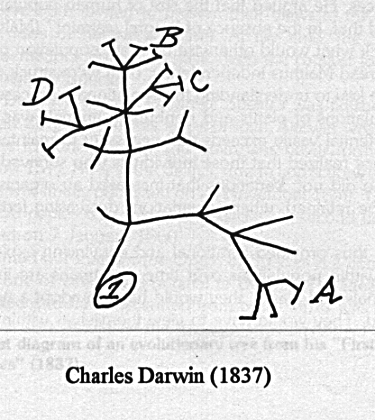
One of the most iconic Darwinian images is his sketch of the 'tree of life' to illustrate his theory that all living creatures have a common ancestor. Darwin claimed that variation was a slow process and that 'no great or sudden modifications were possible' (remember this, it's important!). However, even in Darwin's day, the fossil evidence showed the opposite to this, which Darwin actually acknowledged. He believed that future fossil discoveries would vindicate his theory but that hasn't happened. Instead, scientists have uncovered information about 'the Cambrian explosion'. The Cambrian is a geological period that began 540 million years ago. Prior to this explosion, only jellyfish, sponges and worms were around, but suddenly, with this major explosion, hundreds of new species were born suddenly, out of nowhere, fully developed, that completely disproves Darwin's above quote. Descent from a common ancestor is true within certain species', such as the cat family of cats, tigers, lions etc., but the higher in the taxonomic hierarchy you go, at the level of the major animal groups, the evidence found just does not support Darwin's hypothesis.
 #3 Haeckel's embryos
Ernst Haeckel's comparative drawings of embryos, often described as among the best evidence for Darwinism, are also not what they appear. Haeckel's images depict the embryos of a fish, salamander, tortoise, chicken, hog, calf, rabbit and human side by side in order to emphasise the striking similarities between them, obviously implying that Darwin's theory of a common ancestor is correct.
However, the similarities were faked. Yup, that's right. Faked. When you compare the drawings to photographs, the similarities seem to dwindle. In some cases, Haeckel even used the same woodcut to print embryos from different classes because he was so confident of his theory that he felt he didn't have to draw them individually. In other cases he doctored the images to make them look more similar than they really were. This was exposed in the 1860s when his colleagues accused him of fraud.
His drawings, though, are still used in upper-division textbooks on evolutionary biology, even though Steven Jay Gould of Harvard says that they are 'the equivalent of academic murder'.
Another problem with the drawings is that Haeckel cherry-picked his examples, showing animals that were more similar than he ones he omitted. For example, he used a salamander to represent all amphibians rather than a frog which looks very different. Also, Haeckel claimed the drawings depicted the earliest stages of development when in fact they showed the mid-point of development. This is relevant because Darwin claimed that similarities in the EARLY stages are evident of a common ancestor but embryologists discern that vertebrate embryos look very different in the early cell division stages, more similar in the mid-stages and then begin to look very different again. By drawing embryos at their midpoint and claiming that they were instead at their earliest stages in order for the results to agree with Darwin's theory, there is no doubt about it - Haeckel was manipulating the experiment in order to gain the results he wanted.
 #5 The archaeopteryx
When Darwin wrote 'The Origin of Species' he was well aware that fossil records failed to substantiate his theory. He attributed this problem to the fossil record being incomplete and predicted that future fossil discoveries would vindicate his theory. Sure enough, two years later, scientists discovered the archaeopteryx, thrilling Darwin's supporters. surely this 'missing link' between birds and reptiles would be the first or many fossil discoveries that would validate Darwin's claims.
However, Wells asserts that the archaeopteryx is anything but half-bird, half-reptile, saying 'It's a bird with modern feathers and birds are very different from reptiles in many important ways - their breeding system, their bone structure, their lungs and their distribution of weight and muscles. It's a bird, that's clear. Not part bird and part reptile.' Palaeontologists are agreed that the archaeopteryx is not the ancestor of modern birds. Larry Martin said that it is not an ancestor of modern birds but a member of a totally distinct group of birds. Even ardent evolutionist Pierre Lecomte du Nouy says 'We are not even authorised to consider the archaeopteryx as a true link.'
Since then scientists have been desperate to find the missing link between birds and reptiles, at almost any cost. A few years ago the National Geographic society announced they had found a link between birds and dinosaurs and showed an animal with the tail of a dinosaur and forelimbs of a bird, calling it the archaeoraptor, before a Chinese palaeontologist proved that someone had glued a dinosaur tail to a primitive bird - it was a hoax!
Wells said 'fakes are coming out of the fossil beds all the time because the fossil dealers know there's big money in it.' This has been backed up by ornithologist Alan Feduccia, a evolutionary biologist who said 'Archaeoraptor ia just the tip of the iceberg. There are scores of fake fossils out there and they have cast a dark shadow over the whole field. When you go to these fossil shows, it's difficult to tell which ones are faked and which ones are not. I have heard there is a fake fossil factory in northeast China, in Liaoning Province, near the deposits where many of these recent alleged feathered dinosaurs were found.'
Another example is that of the dinosaur 'bambiraptor', with added feathers and the artificial eyes used on stuffed eagles to make it appear more birdlike. Yet another forgery is that of the 'ape to man' illustrations that are the ultimate icon of Darwinism.
 'Java man' as this missing link between apes and humans is nicknamed, is the result of Eugine Dubois digging some bones up from a riverbank in 1892 which he dated back half a million years. However, Java man consisted of nothing more than a skullcap, femur (thigh bone) and three teeth. The lifelike depiction of Java man was nothing more than speculation fuelled by evolutionary expectations of what he SHOULD have looked like IF Darwinism were true.
More recently discovered, Dubois' excavation would have disqualified the fossil from consideration by today's standards. In 1939, two experts, Ralph von Koenigswald and Franz Weidenreich revealed that Java man was a normal human being and Ernst Mayr from Havard also classified Java man as human in 1944. The femur didn't actually belong with the skullcap, and the skullcap itself, according to Sir Arthur Keith was distinctly human. A 342-page scientific report by 19 evolutionists also concluded that Java man played no part in human evolution.
Henry Gee, science writer for Nature, concluded that 'the conventional picture of human evolution is a completely human invention created after the fact and shaped to accord with human prejudices.'
 So to conclude? I'm not saying that over time species' can't change for the better. I'm merely highlighting the fact that some of the 'best' recorded evidence for Darwinism is either fraudulent or misleading. It's up to you to decide what that means for you. It sickens me to think that in schools, colleges and even universities all over the world, false information is being passed off as fact, information that science knows is false but refuses to correct because not only would it mean admitting that they are wrong about evolution but also that they essentially still have no idea how we are here.
Now, ever since I can remember, the educational system has taught me and my peers about evolution as if it were fact. I remember seeing the picture that depicts ape's rise to man, learning about fossils and how of course 'we all used to be fish' even in primary school. When I got to my first year of secondary school, my science group was named the 'Darwin group' and I remember learning about the survival of the fittest, watching the same video of the Galapagos islands over and over again while trying not to fall asleep staring at the pictures of Darwin that adorned the walls of our classroom.
I never stopped to question it. The theory made sense, we were shown an example of two that seemed to qualify it, and besides, I was more interested in boys than biology. I believed unquestioningly in Darwinism until I read "The Case for a Creator" by Lee Strobel. Strobel is an investigative journalist and former atheist who, upon his wife's conversion to Christianity, decided to speak to some of the world's most esteemed scientists in order to try and answer what he thought was a question with an obvious answer - has science disproved God?
The first part of the book concentrates on Darwinism and whether it's really as fool-proof and untouchable as the world is being led to believe. The scientist that Strobel interviews for this part of the book is Jonathan Wells, PHD, PHD, who has a doctorate in molecular and cell biology, a doctorate in religious studies, has worked as a research biologist and wrote in many scholarly journals and articles, as well as authoring a book 'Icons of Evolution' that examines the key things that we are taught in school about evolution and finds them to be 'either false or misleading'.
The definition of evolution is that 'all living creatures are modified descendants of a common ancestor', not, as so many people believe, the assertion that all organisms within a single species are related through descent with modification, which all scientists will agree is a fact. Below are some examples of things the majority of us have been taught in schools that Wells has found to be false.
#1 The Stanley Miller experiment
In 1953 Stanley Miller shot electricity through an atmosphere like the one on primitive earth and created amino acids, the building blocks of life, the implication being that life could be created naturalistically, leaving no room for a creator, or 'God'. However, Miller used a hydrogen-rich mixture of methane, ammonia and water vapour to simulate the atmosphere of the early earth, but it has since been proven that the atmosphere on early earth was not like this at all but was instead made up of carbon dioxide, nitrogen and water vapour. When the experiment is repeated using a more realistic atmosphere, it is not amino acids that are produced but formaldehyde and cyanide - molecules that kill embryos - not exactly the right substrate for the origin of life!
Shockingly, none of this is in modern day textbooks so students everywhere are being taught information that is not misleading, but downright false.

#2 Darwin's 'Tree of Life'
One of the most iconic Darwinian images is his sketch of the 'tree of life' to illustrate his theory that all living creatures have a common ancestor. Darwin claimed that variation was a slow process and that 'no great or sudden modifications were possible' (remember this, it's important!). However, even in Darwin's day, the fossil evidence showed the opposite to this, which Darwin actually acknowledged. He believed that future fossil discoveries would vindicate his theory but that hasn't happened. Instead, scientists have uncovered information about 'the Cambrian explosion'. The Cambrian is a geological period that began 540 million years ago. Prior to this explosion, only jellyfish, sponges and worms were around, but suddenly, with this major explosion, hundreds of new species were born suddenly, out of nowhere, fully developed, that completely disproves Darwin's above quote. Descent from a common ancestor is true within certain species', such as the cat family of cats, tigers, lions etc., but the higher in the taxonomic hierarchy you go, at the level of the major animal groups, the evidence found just does not support Darwin's hypothesis.
Ernst Haeckel's comparative drawings of embryos, often described as among the best evidence for Darwinism, are also not what they appear. Haeckel's images depict the embryos of a fish, salamander, tortoise, chicken, hog, calf, rabbit and human side by side in order to emphasise the striking similarities between them, obviously implying that Darwin's theory of a common ancestor is correct.
However, the similarities were faked. Yup, that's right. Faked. When you compare the drawings to photographs, the similarities seem to dwindle. In some cases, Haeckel even used the same woodcut to print embryos from different classes because he was so confident of his theory that he felt he didn't have to draw them individually. In other cases he doctored the images to make them look more similar than they really were. This was exposed in the 1860s when his colleagues accused him of fraud.
His drawings, though, are still used in upper-division textbooks on evolutionary biology, even though Steven Jay Gould of Harvard says that they are 'the equivalent of academic murder'.
Another problem with the drawings is that Haeckel cherry-picked his examples, showing animals that were more similar than he ones he omitted. For example, he used a salamander to represent all amphibians rather than a frog which looks very different. Also, Haeckel claimed the drawings depicted the earliest stages of development when in fact they showed the mid-point of development. This is relevant because Darwin claimed that similarities in the EARLY stages are evident of a common ancestor but embryologists discern that vertebrate embryos look very different in the early cell division stages, more similar in the mid-stages and then begin to look very different again. By drawing embryos at their midpoint and claiming that they were instead at their earliest stages in order for the results to agree with Darwin's theory, there is no doubt about it - Haeckel was manipulating the experiment in order to gain the results he wanted.

When Darwin wrote 'The Origin of Species' he was well aware that fossil records failed to substantiate his theory. He attributed this problem to the fossil record being incomplete and predicted that future fossil discoveries would vindicate his theory. Sure enough, two years later, scientists discovered the archaeopteryx, thrilling Darwin's supporters. surely this 'missing link' between birds and reptiles would be the first or many fossil discoveries that would validate Darwin's claims.
However, Wells asserts that the archaeopteryx is anything but half-bird, half-reptile, saying 'It's a bird with modern feathers and birds are very different from reptiles in many important ways - their breeding system, their bone structure, their lungs and their distribution of weight and muscles. It's a bird, that's clear. Not part bird and part reptile.' Palaeontologists are agreed that the archaeopteryx is not the ancestor of modern birds. Larry Martin said that it is not an ancestor of modern birds but a member of a totally distinct group of birds. Even ardent evolutionist Pierre Lecomte du Nouy says 'We are not even authorised to consider the archaeopteryx as a true link.'
Since then scientists have been desperate to find the missing link between birds and reptiles, at almost any cost. A few years ago the National Geographic society announced they had found a link between birds and dinosaurs and showed an animal with the tail of a dinosaur and forelimbs of a bird, calling it the archaeoraptor, before a Chinese palaeontologist proved that someone had glued a dinosaur tail to a primitive bird - it was a hoax!
Wells said 'fakes are coming out of the fossil beds all the time because the fossil dealers know there's big money in it.' This has been backed up by ornithologist Alan Feduccia, a evolutionary biologist who said 'Archaeoraptor ia just the tip of the iceberg. There are scores of fake fossils out there and they have cast a dark shadow over the whole field. When you go to these fossil shows, it's difficult to tell which ones are faked and which ones are not. I have heard there is a fake fossil factory in northeast China, in Liaoning Province, near the deposits where many of these recent alleged feathered dinosaurs were found.'
Another example is that of the dinosaur 'bambiraptor', with added feathers and the artificial eyes used on stuffed eagles to make it appear more birdlike. Yet another forgery is that of the 'ape to man' illustrations that are the ultimate icon of Darwinism.

More recently discovered, Dubois' excavation would have disqualified the fossil from consideration by today's standards. In 1939, two experts, Ralph von Koenigswald and Franz Weidenreich revealed that Java man was a normal human being and Ernst Mayr from Havard also classified Java man as human in 1944. The femur didn't actually belong with the skullcap, and the skullcap itself, according to Sir Arthur Keith was distinctly human. A 342-page scientific report by 19 evolutionists also concluded that Java man played no part in human evolution.
Henry Gee, science writer for Nature, concluded that 'the conventional picture of human evolution is a completely human invention created after the fact and shaped to accord with human prejudices.'

Thursday, 28 June 2012
The Friend Zone
This blog is in response to my friend Liam's entry (see http://paintthesilence1.blogspot.co.uk/2012/06/friend-zone.html). Although extremely well-written with well-argued points, I have to say that I disagree with the entire concept of the male attitude towards the 'friend zone' and consequently this article really wound me up, not because of anything Liam had said, but because of 'advice' that other, successful websites are churning out in relation to men being 'friend zoned' by female friends.
Obviously, being 'friend zoned' can't be a pleasant experience, especially if the recipient is a nice guy that simply isn't well-versed in the art of flirtation and so prefers to take a more indirect approach by treating his female friends as just that, friends, when in actual fact he wants more, but I have to say (and I won't be winning any male supporters in saying this) if you are friend zoned, it is your fault, and I think that most girls will agree with me on this.
I'll make it simple. Girls favour a direct approach. I personally believe that the world would be a much less complicated place (and more people would get lucky in love) if they were honest about their feelings. If a guy is explicitly telling me he likes me, flirting with me, or asks me to go on a date with him, then I have the option of giving him two answers:
a) If I like the guy, I'll say yes and we'll see how we get along, both assured that we find the other attractive and so we don't need to worry 'does he/she likes me?' because it has already been established, or:
b) If I'm not attracted to him, I'll say no. Sure, rejection may be tough for the male pride to deal with at first but it's honest, it gives them a direct answer and leaves them free to ask somebody else out on a date. The man doesn't have to tolerate my platonic company for months before being rejected. He gets it out of the way as soon as his feelings become obvious to him, and it avoids awkward or messy ends.
I'm pretty direct myself. If I don't get the impression that somebody is attracted to me, I'll leave it alone, but if I do, my feelings will be pretty obvious. I don't see a point in beating around some metaphorical bush. It isn't embarrassing to be attracted to somebody, it's flattering if anything, and if they don't feel the same way about you then at least you'll have boosted their confidence and made them feel good about themselves. Really, what is the worst that can happen by being direct?
So why then, will men not learn?
It's common knowledge that men are commonly seduced by their eyes, meaning that if their leggy blonde friend turns around after two years of platonic friendship and expresses a desire for more, men will probably not understand the concept of 'but she's my friend, it would be weird' because they are visual creatures, and as long as they find their friend physically appealing, the fact that they are friends is not an issue. I know that not every single man in the entire world thinks this way but I'm applying a general rule that seems to fit the majority in order to illustrate my point, and hopefully give this kind of man a female perspective on it.
However, girls are more auditory creatures, meaning we are seduced by our ears. I am more likely to fall for somebody if they are flirtatious, funny and a bit cheeky than if they are an Adonis Greek god. For example, I could be friends with a male model for years and not want anything more BECAUSE WE ARE FRIENDS, and then somebody less physically attractive could come along and flirt with me and I'd be more likely to see him as a potential mate because he's making his intentions clear and 'seducing' me via the words he uses, rather than relying on a pretty face or years of friendship getting him some sort of creepy Brownie points.
Now, a little misunderstanding is fine. If guys insist on carrying on with the whole 'I'll be friends with her and secretly hope for more' approach which will inevitably lead to disappointment, as long as they're only hurting themselves, who am I to complain? However, often the guys aren't the only ones that get hurt in situations like this, but with their egocentric way of looking at the world, they don't see this and will more than likely see the girl in question as someone who 'led me on' before 'going for the wrong guy when I can make her happier'.
First off, quit with the 'she led me on' bullshit. I love my guy friends to bits. I make time to see them often and we always have a laugh together. If one of them were to turn around and say that my behaviour towards them qualified as 'leading them on' then I'd tell them to get their head out of their arse because if somebody is my FRIEND then of course I am nice to them and will give them more special treatment than a stranger on the street. 'Leading you on' would be telling you I liked you and telling you we have a future together, before getting with somebody else out of the blue, and as far as I am aware, girls aren't in the habit of doing that for kicks.
As for 'going for the wrong kind of guys', who are you to say that you could make her happier than the people she's actually attracted to? How arrogant are you to presume that the guys she actually likes are the 'wrong' kind? I'd much rather have a guy who was upfront about his intentions to sleep with me than somebody that pretended to be my friend and really care about me for months when in actual fact he runs home after seeing me to masturbate onto pictures of us together. I know which one I consider to be the more immoral of the two.
Many a time in the past, I've made friends with a guy, and been happy about it (because what's not to like about having a new friend?), and we've got along like a house on fire, talking about the people we like, getting drunk together, hanging about in the same circles, before the guy has told me he has feelings for me, I've responded that because we've been friends for months that's the way I now see him, and he's disappeared off the face of the earth. Am I to assume that our whole friendship was a fraud, a ploy to get me to fall in love with him and when that failed, he saw no reason to continue the friendship? I find that disgusting. It's false advertising, effectively 'leading somebody on' in the sense that you're pretending to be somebody's best friend when in actual fact your plan is to run a mile if that's all the girl wants to be.
Personally I think that boys need to grow up. Get some balls and tell a girl that you like that you like her. Don't pretend to be her friend for months before confessing your feelings because then you will have missed the boat and will only have yourself to blame. And don't, under any circumstance, try and manipulate your way out of the zone by subtly changing your behaviour towards the girl in question in some sort of weird ploy to trick her into feeling differently.
Liam quoted a site that advised people to be more touchy feely and play 'hard to get' by not seeing your friend as much, the ultimate goal of this being that absence will make their heart grow fonder and you will come back to your female friend lying naked on a bed covered in strawberries and cream. I cannot stress enough how important it is that you don't do this. If I found out that somebody I'd been close friends with for years was actually playing these sort of manipulative mind games with me (because that's what they are) then I'd be livid.
The trick to getting the girl is simple. As soon as you meet her, make your intentions clear. The worst that can happen is that your pride is wounded slightly if she doesn't find you attractive. Two examples of this being successful come from two of my best guy friends. I won't name them in case they think I'm ruining their chances with the ladies here but I know for a fact that in the past, both of the guys had lacked confidence around the opposite sex and as a result had had to suffer the 'friend zone' time and time again. However, on coming to university, you wouldn't think that at all. In clubs they approach all the girls they find attractive, because as one of them said 'the more you approach, the more chance someone's going to like you. If you don't approach them you're guaranteed not to get any girls', and it works! These guys see a girl they like and flirt with them, leaving no mystery as to their intentions. What they don't do is pretend to be honourable gentlemen whose only desire is to watch Twilight with girls and listen to them talk about other boys.
Don't, boys, under any circumstances pretend to be her friend, listening to her problems and showing a genuine interest in her feelings if you have an ulterior motive. It's shady, creepy and downright disrespectful. And guys, do us girls a favour and don't label us as cold hearted sluts if we aren't attracted to you. It's really not our fault if you fail to impress so stop shifting blame.

Subscribe to:
Posts (Atom)